
Building a resilient investment strategy requires looking beyond traditional stocks and bonds. A proper gold portfolio allocation provides critical balance, acting as a structural anchor when markets face extreme volatility. By understanding how to position precious metals effectively, you can protect your purchasing power and optimize your risk-adjusted returns over the long term.
This comprehensive guide explores the mechanics of integrating precious metals into your investment strategy. You will learn optimal allocation percentages based on your risk profile, compare physical bullion against modern investment vehicles like ETFs, and discover expert frameworks for rebalancing. Mastering these concepts ensures your wealth remains protected during economic uncertainty.
The Strategic Role of Gold Portfolio Allocation
Investors have relied on precious metals for centuries to preserve wealth across multiple generations. However, the modern financial landscape requires a more analytical approach to asset placement. Rather than viewing precious metals simply as a crisis hedge, financial professionals now recognize them as a core component of structural resilience. The transition from a standard 60/40 stock and bond mix to a more diversified framework highlights the necessity of alternative assets.
Equities generate growth through corporate earnings, while bonds provide income through interest payments. Precious metals operate differently. They do not produce a yield, but they carry no counterparty risk. This unique characteristic means their value cannot be erased by a corporate bankruptcy or a sovereign debt default. Integrating them into your holdings introduces an orthogonal return stream, meaning their price movements operate independently from the broader financial system.
When you analyze market cycles, the true value of this independence becomes clear. During periods of economic expansion, growth assets naturally dominate performance charts. Yet, when central banks alter monetary policy or geopolitical tensions rise, correlations between equities and fixed income often converge. Assets that historically moved in opposite directions suddenly decline together. This correlation breakdown exposes traditional investors to significant drawdowns.
Adding precious metals establishes a reliable counterbalance. The primary objective is not necessarily to beat the stock market, but to smooth out the overall volatility curve. By reducing the depth of portfolio drawdowns, you require less aggressive returns just to recover your initial capital.
Why Diversification Still Matters
True diversification requires owning assets that react differently to identical economic stimuli. If every asset you own relies on low interest rates and high corporate profits to succeed, you are simply taking on concentrated economic risk under different ticker symbols.
Precious metals carry a near-zero correlation to the S&P 500 over extended timeframes. When stock markets experience severe corrections, investors immediately seek liquidity and safety. This flight to quality historically drives capital into tangible assets. You can observe this dynamic by studying major crisis periods over the last fifty years.
Furthermore, you must consider the psychological benefits of proper diversification. Watching a fully allocated equity portfolio drop by thirty percent often triggers emotional selling. Holding an asset class that holds its ground or appreciates during these stressful periods provides the psychological fortitude necessary to stick to your long-term plan. For comprehensive guidance on building resilient frameworks, exploring advanced asset allocation strategies can significantly improve your structural design.
Inflation and Currency Debasement Protection
The purchasing power of fiat currency continuously erodes due to structural inflation and monetary expansion. Central banks manage economic growth by expanding the money supply, which inherently devalues existing currency units.
Since the end of the Bretton Woods system in 1971, the correlation between global money supply growth and precious metal valuation has remained distinctly positive. When governments increase deficit spending and expand their balance sheets, investors naturally gravitate toward assets with a strictly limited supply. You cannot print tangible commodities.
This finite nature creates a reliable store of value. While short-term price fluctuations occur based on interest rate expectations and dollar strength, the long-term trajectory typically mirrors the expansion of the fiat currency supply. By maintaining a dedicated allocation, you effectively insure a portion of your wealth against the hidden tax of inflation and aggressive monetary debasement.
Historical Performance: Gold vs. Traditional Assets
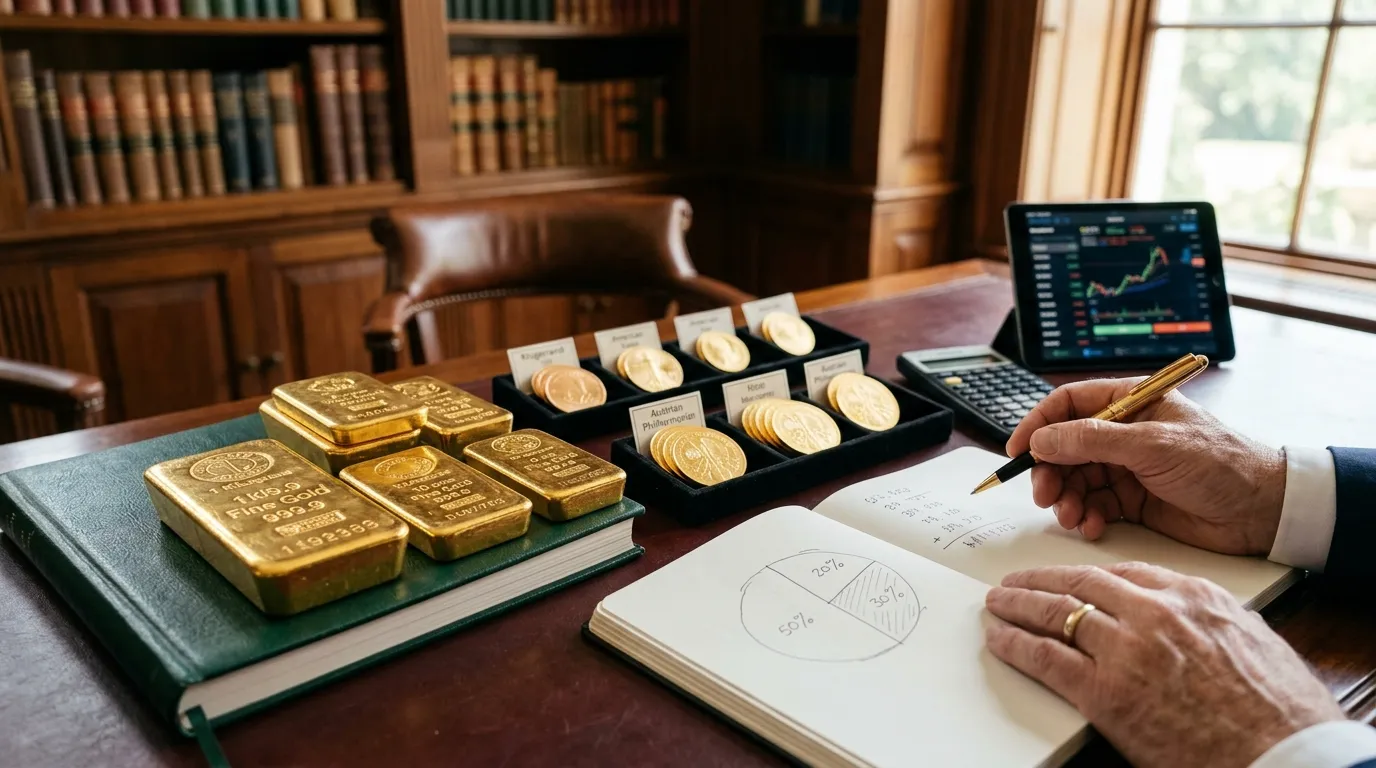
To truly understand how precious metals function within a diversified strategy, we must examine historical performance data across various economic climates. Over a fifty-year horizon, the annualized returns of precious metals have largely tracked those of global fixed-income markets, while trailing broad equity indices. However, viewing raw returns in isolation paints an incomplete picture of portfolio mechanics.
The true metric of investment success is risk-adjusted return. This calculation evaluates how much volatility an investor must endure to achieve a specific level of growth. By integrating an uncorrelated asset into a traditional mix of stocks and bonds, historical backtests consistently demonstrate an improvement in the overall Sharpe ratio. The portfolio achieves higher returns per unit of risk taken.
For example, data provided by the World Gold Council frequently illustrates how portfolios with a modest precious metals allocation experience shallower drawdowns and faster recovery periods compared to traditional unhedged portfolios. The mathematical benefit of compounding kicks in faster when you do not have to dig yourself out of massive capital holes.
Crisis Periods and Market Drawdowns
The real-world application of this theory becomes evident during severe macroeconomic shocks. During the 2008 global financial crisis, global equities lost more than a third of their value. During that exact same window, precious metals experienced substantial gains, offsetting equity losses and providing crucial liquidity for investors who needed cash.
A similar dynamic unfolded during the early stages of the 2020 global pandemic. As equity markets crashed violently in March, precious metals quickly established a price floor and proceeded to set new all-time highs by late summer. The negative correlation spike precisely when it was needed most demonstrates the structural insurance value of the asset.
Analyzing the 60/40 Portfolio Shift
The foundational 60/40 portfolio (60% equities, 40% bonds) served investors remarkably well during a forty-year structural bond bull market. As interest rates steadily declined from their peak in the early 1980s, bonds provided both reliable income and capital appreciation.
That macroeconomic regime has shifted. With interest rates normalizing and inflation demonstrating persistent structural stickiness, bonds can no longer be relied upon as an infallible shock absorber. Leading financial institutions, including Morgan Stanley, have highlighted the necessity of real assets in modern portfolio construction. Many strategists now advocate for a modified 60/20/20 framework, where the final twenty percent is dedicated to real assets and alternative investments.
This structural evolution acknowledges that future economic shocks will likely stem from fiscal dominance and supply chain constraints, environments where tangible commodities traditionally excel over paper promises.
Determining Your Ideal Gold Allocation Percentage

The most common question investors ask is exactly how much capital should be dedicated to precious metals. There is no universal answer that applies to every individual. Your optimal allocation depends entirely on your time horizon, risk tolerance, and broader financial objectives.
Financial advisors generally recommend an allocation ranging from five to fifteen percent of your total investable assets. Going below five percent typically renders the diversification benefits mathematically insignificant during a crisis. Exceeding twenty percent often creates a drag on long-term capital compounding, as you substitute too much growth potential for defensive posturing. Understanding portfolio rebalancing techniques helps keep these percentages aligned with your goals over time.
Conservative Investors (5-10%)
Investors who are approaching retirement or prioritizing capital preservation over aggressive growth generally fall into the conservative category. For this demographic, a five to ten percent allocation serves as a prudent insurance policy.
At this level, the allocation provides meaningful downside protection against sudden equity shocks or inflationary spikes. It stabilizes the daily fluctuations of the total portfolio value without requiring the investor to sacrifice the income generated by dividend-paying stocks and high-quality bonds. Conservative investors should primarily focus on highly liquid investment vehicles, ensuring they can access their capital efficiently if living expenses unexpectedly rise.
Balanced Strategies (7-12%)
Investors in their peak earning years with a moderate risk tolerance benefit from a slightly heavier allocation, typically ranging from seven to twelve percent. This middle-ground approach allows for a robust defense against currency debasement while leaving ample room for aggressive growth assets.
A balanced investor might choose to split their precious metals exposure between different forms of ownership. They could hold physical bullion for long-term foundational wealth preservation while using liquid exchange-traded funds to capitalize on medium-term price trends. This flexibility allows them to dynamically adjust their risk exposure based on evolving macroeconomic data.
Aggressive Approaches (10-15%)
Younger investors or those with an exceptionally high risk tolerance might push their allocation toward the ten to fifteen percent range. While this seems counterintuitive since younger investors typically favor pure growth, an aggressive precious metals stance often involves specialized vehicles.
Instead of strictly holding physical bullion, an aggressive investor will allocate a significant portion of this bucket toward mining equities and capital-efficient structured funds. These vehicles introduce operational leverage. When commodity prices rise, the profit margins of mining companies expand exponentially, providing equity-like returns driven by commodity fundamentals. This strategy requires a strong stomach for volatility but offers substantial upside during commodity super-cycles.
Modern Methods for Investing in Precious Metals

Technology and financial innovation have drastically expanded the avenues available for commodity investing. You are no longer restricted to hiding coins in a safe deposit box. Each investment vehicle carries distinct advantages, tax implications, and risk profiles that must be carefully evaluated.
Physical Bullion (Coins and Bars)
Direct ownership of physical coins and bars represents the most traditional form of commodity investment. The primary advantage of physical bullion is the complete elimination of counterparty risk. When you hold a physical coin, your wealth is not dependent on the solvency of a bank, brokerage firm, or digital network.
Investors typically focus on sovereign-minted coins, such as American Eagles or Canadian Maple Leafs, due to their instant global recognizability and strict purity standards. Bars offer lower premiums over the spot price, making them efficient for bulk purchases.
However, physical ownership introduces logistical challenges. You must secure safe storage, either through a heavy-duty home safe or a third-party vaulting facility. Additionally, physical metals require specialized insurance policies, and liquidating large quantities can take several days and involve dealer spreads.
Gold Exchange-Traded Funds (ETFs)
Exchange-Traded Funds revolutionized commodity investing by allowing individuals to gain direct price exposure through their standard brokerage accounts. Funds like the SPDR Gold Shares (GLD) physically hold the metal in secure vaults and issue shares representing fractional ownership.
The advantages here are liquidity and convenience. You can buy and sell shares instantly during standard market hours with minimal bid-ask spreads. You completely bypass the headaches of shipping, storage, and personal insurance.
The downside is the introduction of counterparty risk and ongoing management fees. You rely on the fund sponsor to accurately audit and secure the underlying assets. Furthermore, ETFs are taxed as collectibles under US tax law, which carries a higher maximum long-term capital gains rate compared to traditional equities.
Gold Mining Stocks and Mutual Funds
Investing in the companies that extract resources from the ground offers a completely different risk-return profile. Mining stocks provide leverage to the underlying commodity price. If it costs a company one thousand dollars to extract an ounce of metal, and the market price rises from two thousand to two thousand five hundred dollars, the commodity price increased by twenty-five percent, but the company’s profit margin increased by fifty percent.
This operational leverage makes mining stocks incredibly attractive during bull markets. Some established miners also pay shareholder dividends, providing cash flow from a traditionally non-yielding asset class.
However, mining equities carry severe operational risks. Political instability in mining jurisdictions, labor strikes, environmental disasters, and rising energy costs can destroy a company’s stock price even if the underlying commodity is surging. Therefore, investors often use broad mining ETFs to mitigate single-stock risk.
Capital-Efficient Strategies
Recent financial innovations have introduced capital-efficient funds designed to maximize portfolio utility. These strategies utilize futures contracts to provide dual exposure within a single ticker symbol.
For example, a capital-efficient fund might invest ninety percent of its assets in a standard S&P 500 equity basket while using the remaining ten percent as collateral to secure futures contracts on precious metals. This provides the investor with full equity market participation alongside a nearly equivalent notional exposure to the commodity.
This structure allows investors to maintain their desired defensive commodity allocation without sacrificing any growth potential from their core equity holdings. It represents a modern evolution of portfolio design, though investors must understand the mechanics of futures roll yields and slight tracking errors inherent to these products.
Comparison Table: Physical Gold vs. ETFs vs. Mining Stocks
To assist in your asset allocation decisions, the following table breaks down the primary characteristics of the three main investment vehicles.
|
Feature |
Physical Bullion |
Commodity ETFs |
Mining Equities |
|---|---|---|---|
|
Counterparty Risk |
None |
Low to Moderate |
High (Corporate/Operational) |
|
Liquidity |
Low (Days to sell) |
High (Instant during market hours) |
High (Instant during market hours) |
|
Storage Costs |
High (Vaults/Insurance) |
Ongoing expense ratio |
None |
|
Income Generation |
None |
None |
Potential Dividends |
|
Volatility |
Low |
Low |
Very High |
|
Tax Treatment (US) |
Collectible Rate (Max 28%) |
Collectible Rate (Max 28%) |
Standard Capital Gains |
Pro Tips from Financial Experts
To maximize the efficiency of your precious metals strategy, top financial advisors recommend implementing the following professional tactics:
- Implement Systematic Dollar-Cost Averaging: Instead of attempting to buy a massive position at the absolute bottom of a market correction, allocate a fixed dollar amount every month. This strategy automatically purchases more ounces when prices are low and fewer when prices are high, mathematically smoothing out your average entry price over time.
- Utilize Tax-Advantaged Accounts: Because physical metals and related ETFs are often subject to higher collectible tax rates, consider placing these assets inside a Self-Directed IRA or similar tax-advantaged vehicle. This structure shelters your capital gains from immediate taxation, allowing your wealth to compound more efficiently.
- Establish Hard Rebalancing Rules: Emotion is the enemy of successful investing. Set a strict percentage tolerance for your allocation. If your target is ten percent, and a massive price rally pushes the allocation to fifteen percent, systematically sell the excess five percent and reallocate the profits into underperforming asset classes. This forces you to sell high and buy low.
- Audit Your Storage Solutions: If you choose physical ownership, never store massive amounts of wealth at home without a specialized insurance rider. Standard homeowners policies rarely cover substantial bullion losses. Utilize segregated, non-bank vaulting facilities for significant holdings.
Common Mistakes to Avoid When Investing in Gold
Even experienced investors frequently make strategic errors when incorporating precious metals into their broader financial plans. Recognizing these psychological and mechanical pitfalls will save you significant capital.
Over-Allocating Driven by Fear
The most destructive mistake investors make is panic buying during an acute economic crisis. When stock markets collapse and news headlines predict financial doom, investors often liquidate their equities at market bottoms and immediately dump their entire net worth into precious metals at the absolute top of a fear-driven price spike.
This violates every principle of structural portfolio design. By the time panic hits the mainstream media, the protective price move has already occurred. Building your allocation must be a proactive, not reactive, endeavor. Maintaining a steady, predetermined percentage prevents fear from dictating your financial future.
Ignoring Storage and Insurance Costs
First-time physical buyers often calculate their returns based purely on the spot price of the metal. They fail to account for the frictional costs of ownership. Dealer premiums can add five to ten percent to the purchase price immediately. Then, annual safe deposit box fees or private vaulting costs eat into the capital base.
If you do not factor in the cost of secure storage and specialized insurance, your actual realized return will be significantly lower than the market charts suggest. Always calculate your total cost of ownership before deciding between physical bullion and liquid ETFs.
Trying to Time the Market
Attempting to predict short-term fluctuations based on federal reserve meeting minutes or geopolitical news events is a losing game. Commodity markets are incredibly complex, driven by global supply chain logistics, central bank purchasing, and algorithmic currency trading.
Trying to trade in and out of your precious metals allocation invariably leads to missed opportunities and excessive capital gains taxes. Your defensive allocation is designed to be a permanent, structural pillar of your wealth. Treat it as long-term financial insurance rather than a short-term trading vehicle. If you constantly buy and sell your insurance policy, it won’t be there when the house actually catches fire. For a deeper understanding of long-term positioning, review insights on wealth preservation methodologies.
Conclusion
Constructing a durable investment strategy demands assets that can withstand various macroeconomic shocks. A disciplined gold portfolio allocation serves as an essential counterweight to traditional equities and bonds, offering vital protection against currency debasement and systemic market volatility. By accurately assessing your risk tolerance, selecting the appropriate investment vehicles, and adhering to strict rebalancing protocols, you establish a resilient financial foundation. Take action today by reviewing your current asset breakdown and making the necessary adjustments to secure your long-term wealth.
Frequently Asked Questions (FAQs)
What is the ideal percentage for a precious metals allocation?
Financial professionals generally recommend an allocation between 5% and 15% of your total investable assets. Conservative investors usually target 5% to 10% for pure wealth preservation, while aggressive investors might allocate up to 15% using higher-volatility mining equities.
Does owning physical bullion provide better returns than an ETF?
Physical bullion and exchange-traded funds track the same underlying spot price, so their gross returns are identical. However, physical bullion incurs storage and insurance costs, while ETFs charge an annual management fee. Physical metal offers safety from counterparty risk, whereas ETFs provide superior liquidity.
Are precious metals highly correlated to the stock market?
Historically, precious metals exhibit a near-zero correlation to broad equity indices like the S&P 500 over long timeframes. During severe economic crises and stock market crashes, this correlation often turns negative, meaning precious metals rise as equities fall.
How are precious metals taxed in standard brokerage accounts?
In the United States, physical bullion and ETFs backed by physical metal are classified as collectibles by the IRS. This means long-term capital gains are taxed at a maximum rate of 28%, which is higher than the standard 15% or 20% long-term capital gains rate applied to traditional stocks.
Do mining stocks carry the same risks as the underlying commodity?
No. Mining stocks introduce significant corporate and operational risks, including geopolitical instability in mining jurisdictions, labor disputes, rising energy costs, and mismanagement. They are generally much more volatile than the underlying commodity.
Can I hold physical metals inside my retirement account?
Yes, you can hold specific types of physical bullion inside a Self-Directed Individual Retirement Account (SDIRA). However, the metals must meet strict IRS purity standards and must be held by an approved third-party custodian, not in your personal possession.
Why do precious metals perform well during high inflation?
Because tangible commodities possess a strictly limited global supply, they cannot be artificially printed or expanded like fiat currencies. As central banks increase the money supply and currency loses its purchasing power, it takes more fiat dollars to purchase the same ounce of metal.
Should I rebalance my precious metals allocation regularly?
Yes, strict portfolio rebalancing is essential. If a massive price rally causes your 10% target allocation to grow to 15%, you should systematically sell the excess 5% and reinvest the profits into other asset classes that are currently underperforming.
What causes short-term drops in commodity prices?
Short-term price fluctuations are heavily influenced by interest rate expectations and the strength of the US Dollar. When interest rates rise significantly, yield-bearing assets become more attractive, causing non-yielding alternative assets to face temporary selling pressure.
Is it better to buy coins or bars for physical storage?
Sovereign-minted coins are highly liquid and globally recognized, making them easy to sell during a crisis, though they carry higher dealer premiums. Bars carry lower premiums over the spot price, making them the preferred choice for massive bulk purchases intended for long-term vault storage.