Have you ever wondered what makes gold so uniquely captivating? For thousands of years, humans have fought over it, adorned themselves with it, and built entire economies around it. But beyond its glittering surface, gold is a fascinating chemical element with a rich scientific profile.
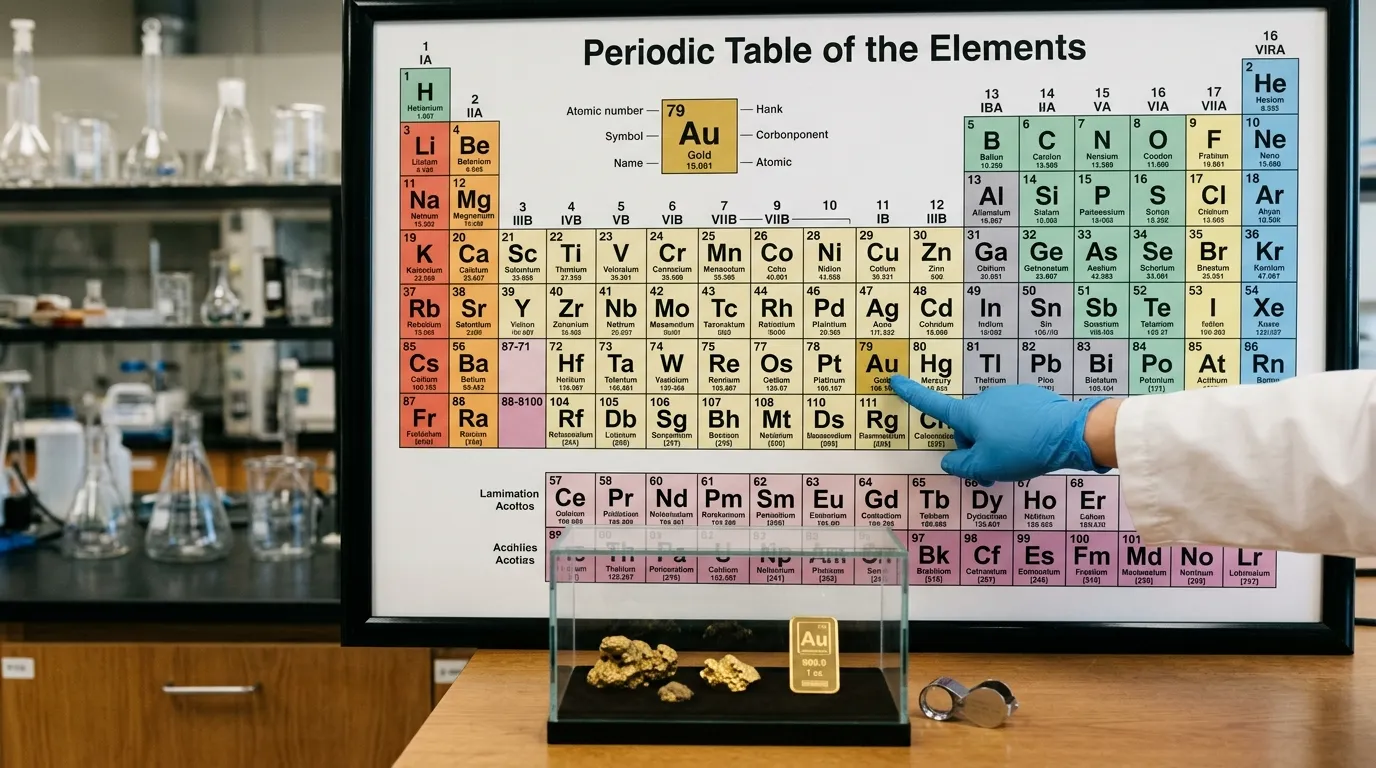
If you want to understand what gold is in the periodic table, you need to look past the jewelry store and dive into the realm of chemistry. Represented by the symbol Au (from the Latin aurum, meaning “shining dawn”) and holding the atomic number 79, gold is a dense, soft, and highly unreactive transition metal.
In this comprehensive guide, we explore the definitive properties of gold, how it is extracted from the earth, its incredibly diverse modern applications, and the lasting environmental and economic impact it carries.
The Defining Properties of Gold

Gold belongs to Group 11 of the periodic table, sharing its column with copper and silver. These are often called the “coinage metals.” When you examine the physical and chemical properties of this element, it becomes clear why it stands out from the crowd.
Physical and Chemical Characteristics
One of the most famous physical traits of this metal is its extreme malleability. You can beat a single gram of gold into a sheet covering one square meter. It is also highly ductile, meaning it can be drawn into a remarkably thin wire without breaking.
Gold is exceptionally dense. A cubic centimeter of gold weighs 19.3 grams, making it heavier than lead. It has a melting point of 1,064.18°C (1,947.52°F) and a boiling point of 2,836°C (5,137°F).
Chemically, gold is a “noble metal,” which means it resists oxidation and corrosion. It does not react with oxygen at any temperature, meaning it will never rust or tarnish. It is unaffected by most standard acids but will dissolve in aqua regia—a potent mixture of nitric and hydrochloric acids.
Atomic Structure
Looking at the atomic level, gold has a fascinating structure. Its electron configuration is [Xe] 4f14 5d10 6s1. The relativistic effects in its electron orbitals absorb blue light, which is exactly what gives the metal its distinctive yellow, golden hue.
When it forms compounds, gold exhibits various oxidation states, most commonly +1 (aurous) and +3 (auric). While you will rarely see gold reacting in nature, scientists leverage these states to create specialized chemical compounds for medicine and industry.
Occurrence and Extraction

Gold is a rare element, making up roughly 0.004 parts per million of the Earth’s crust. Because it is so unreactive, it is mostly found in its native, free state rather than combined with other elements.
Where is Gold Found?
Miners typically find gold in two main types of geological formations:
- Lode deposits (Veins): Gold gets embedded in solid rock, often alongside quartz or pyrite.
- Alluvial (Placer) deposits: Over millions of years, weather erodes lode deposits. Water washes the heavy gold particles into streams and riverbeds, creating concentrations of gold dust or nuggets.
Interestingly, the world’s oceans also contain gold. Seawater holds trace amounts of gold—about 4 grams per 1,000,000 tonnes of water. However, the concentration is so low that extracting it remains entirely unprofitable.
Modern Extraction Methods
Historically, people used panning to filter heavy gold from lighter river gravel. Today, commercial gold extraction relies on massive open-pit or underground mining operations.
Once miners pull gold-bearing rock from the earth, they crush it into a fine powder. To extract the precious metal, they often use a process called cyaniding. They mix the crushed ore with a sodium cyanide solution, which dissolves the gold. They then recover the gold from the solution using zinc or activated carbon. Smelting and electrolysis follow, ensuring the final product reaches high levels of commercial purity.
Diverse Applications of Gold
While you might associate gold purely with wealth and decoration, its unique chemical and physical properties make it indispensable in modern technology and medicine.
Jewelry and Wealth
Roughly 50% of the world’s newly mined gold goes directly into jewelry. Because pure 24-karat gold is too soft for daily wear, jewelers alloy it with metals like copper, silver, or palladium to increase its strength and create variations like rose gold or white gold. Additionally, investors and central banks hoard gold bars and bullion coins as a reliable monetary standard and hedge against inflation.
Electronics and Technology
Gold is a fantastic conductor of electricity and, more importantly, it never corrodes. This makes it perfect for the electronics industry. Almost every computerized device—including the smartphone or computer you are using right now—contains tiny amounts of gold. Manufacturers use it in circuit boards, memory chips, and electrical connectors to ensure reliable, long-lasting data transmission.
Furthermore, aerospace engineers use ultra-thin gold leaf to coat spacecraft and astronauts’ visors. Gold excels at reflecting infrared radiation, protecting delicate equipment and human eyes from the intense heat of the sun.
Medicine and Dentistry
Gold is biologically inert, meaning the human body does not reject it. This has made it a premier material for dental fillings, crowns, and bridges for decades.
In the realm of medicine, gold nanoparticles play a cutting-edge role. Medical researchers use radioactive gold-198 to treat specific types of cancer. Furthermore, specific gold compounds, like auranofin, are prescribed to reduce the severe inflammation associated with rheumatoid arthritis.
Gold in History and Culture
No other element in the periodic table has shaped human history quite like gold. Artifacts found in Bulgaria date back to the 5th millennium BC, proving our ancestors coveted the metal long before recorded history.
Ancient Egyptians adorned their pharaohs in gold, believing it to be the flesh of the gods. The famous funerary mask of Tutankhamun remains one of the most stunning examples of ancient goldsmithing. Later, the Kingdom of Lydia created the world’s first pure gold coins around 560 BC, establishing a medium of exchange that revolutionized global trade.
Throughout the centuries, gold symbolized divinity, purity, and ultimate power. The desire to create gold from base metals drove the ancient practice of alchemy, which eventually laid the groundwork for modern chemistry.
Environmental and Economic Impact
The global appetite for gold drives a massive, multi-billion-dollar economic engine, but it comes at a steep environmental cost.
The Environmental Toll of Mining
Gold mining is highly energy-intensive and disruptive to local ecosystems. Open-pit mining leaves behind massive scars on the earth and generates millions of tons of waste rock.
The most pressing environmental concern revolves around the chemicals used in extraction. Cyanide spills have devastated local river ecosystems in various parts of the world. Furthermore, artisanal and small-scale miners often use mercury to extract gold, leading to severe heavy-metal contamination in local water supplies and posing critical health risks to the miners themselves. To combat this, organizations like the Environmental Protection Agency (EPA) advocate for stricter regulations and cleaner extraction technologies.
Economic Significance
Despite these challenges, the gold industry provides immense economic value. It employs millions of people worldwide, particularly in top producing countries like China, Australia, Russia, and South Africa. Gold serves as a cornerstone asset for national reserves, anchoring the global financial system during times of extreme market volatility.
As we look to the future, the push for recycled gold is gaining momentum. Recovering gold from discarded electronics and old jewelry drastically reduces the carbon footprint compared to traditional mining, paving the way for a more sustainable industry.
Conclusion
From its majestic gleam to its unrivaled stability, gold is much more than a symbol of wealth. As element 79 on the periodic table, it boasts incredible chemical properties that make it vital to our modern way of life. Whether it is ensuring your smartphone functions flawlessly, helping treat severe medical conditions, or stabilizing global economies, gold continues to prove its boundless versatility.
If you want to learn more about how chemistry shapes our world, explore our other guides on transition metals and their industrial applications.
FAQs
What is gold in the periodic table?
Gold is a transition metal located in Group 11 of the periodic table. Its chemical symbol is Au, and it has an atomic number of 79.
Why is the symbol for gold Au?
The symbol Au comes from the Latin word aurum, which translates to “shining dawn.”
Is gold a highly reactive element?
No, gold is a noble metal. It is highly unreactive, meaning it does not tarnish, rust, or react with oxygen and most standard acids.
What does the term malleability mean regarding gold?
Malleability refers to a material’s ability to be pressed or hammered out of shape without breaking. Gold is the most malleable of all metals; a single gram can be beaten into a one-square-meter sheet.
How is gold used in medicine?
Gold is highly biocompatible. Dentists use it for crowns and fillings, while doctors use gold compounds to treat rheumatoid arthritis and radioactive gold isotopes to target specific cancer cells.
What is the electron configuration of gold?
The electron configuration of gold is [Xe] 4f14 5d10 6s1. This specific arrangement of electrons is responsible for the metal’s unique yellow color.
How is gold extracted from ore?
Most commercial operations use a process called cyaniding, where crushed gold ore is mixed with a sodium cyanide solution to dissolve and separate the gold from the surrounding rock.
What are the common oxidation states of gold?
While gold is largely unreactive, when it does form compounds, it most commonly exhibits oxidation states of +1 (aurous) and +3 (auric).
Why do electronics use gold?
Gold is an excellent conductor of electricity and, unlike copper or silver, it never corrodes. This makes it perfect for reliable, long-lasting electrical contacts in computers and smartphones.
Can we extract gold from seawater?
While the world’s oceans contain millions of tons of dissolved gold, the concentration is incredibly low (about 4 parts per trillion). Currently, there is no economically viable method to extract it.