Have you ever looked at a shimmering piece of jewelry or a shiny coin and wondered exactly what gives it that unmistakable luster? Humans have valued this gleaming yellow metal for thousands of years, fighting wars over it, using it as currency, and wearing it as a symbol of ultimate prestige. But beneath the surface beauty, what is gold made of? Understanding the elemental makeup of this fascinating material reveals a story that stretches from the microscopic building blocks of matter all the way to explosive cosmic events in the far reaches of the universe.
This comprehensive guide breaks down the science, origins, and applications of the world’s most famous precious metal. We will explore the precise atomic structure of gold, trace its explosive celestial origins, and examine how it naturally occurs here on Earth. You will also discover its unique physical and chemical properties, its wide array of modern industrial uses, and expert tips for identifying genuine pieces while avoiding common counterfeits.
The Core Elements: Gold’s Atomic Structure
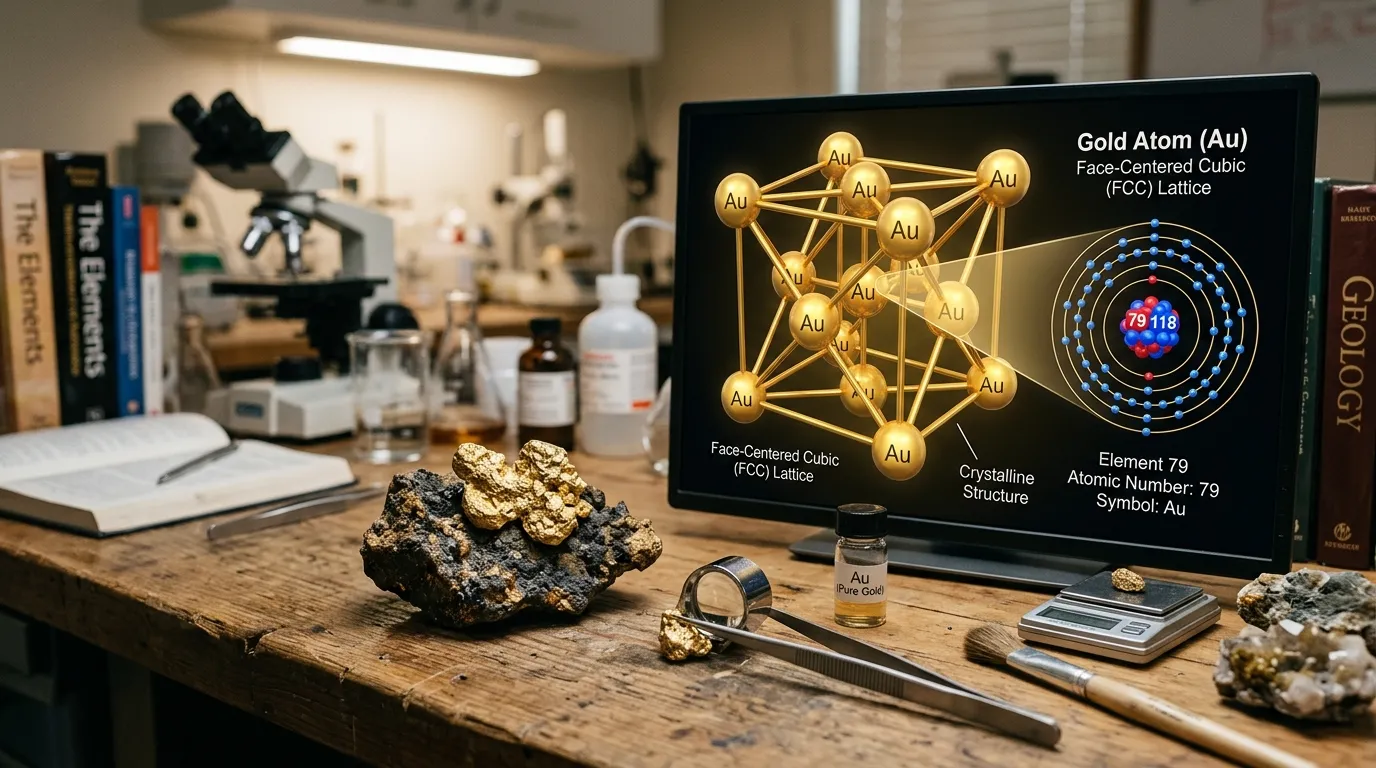
To truly answer what makes up this precious metal, we must zoom in to the microscopic level. Gold is a chemical element, meaning it is a pure substance consisting of only one type of atom. It sits proudly in Group 11 of the periodic table, right alongside other valuable conductive metals like silver and copper. Its chemical symbol is Au, which comes from the Latin word aurum, meaning “shining dawn.”
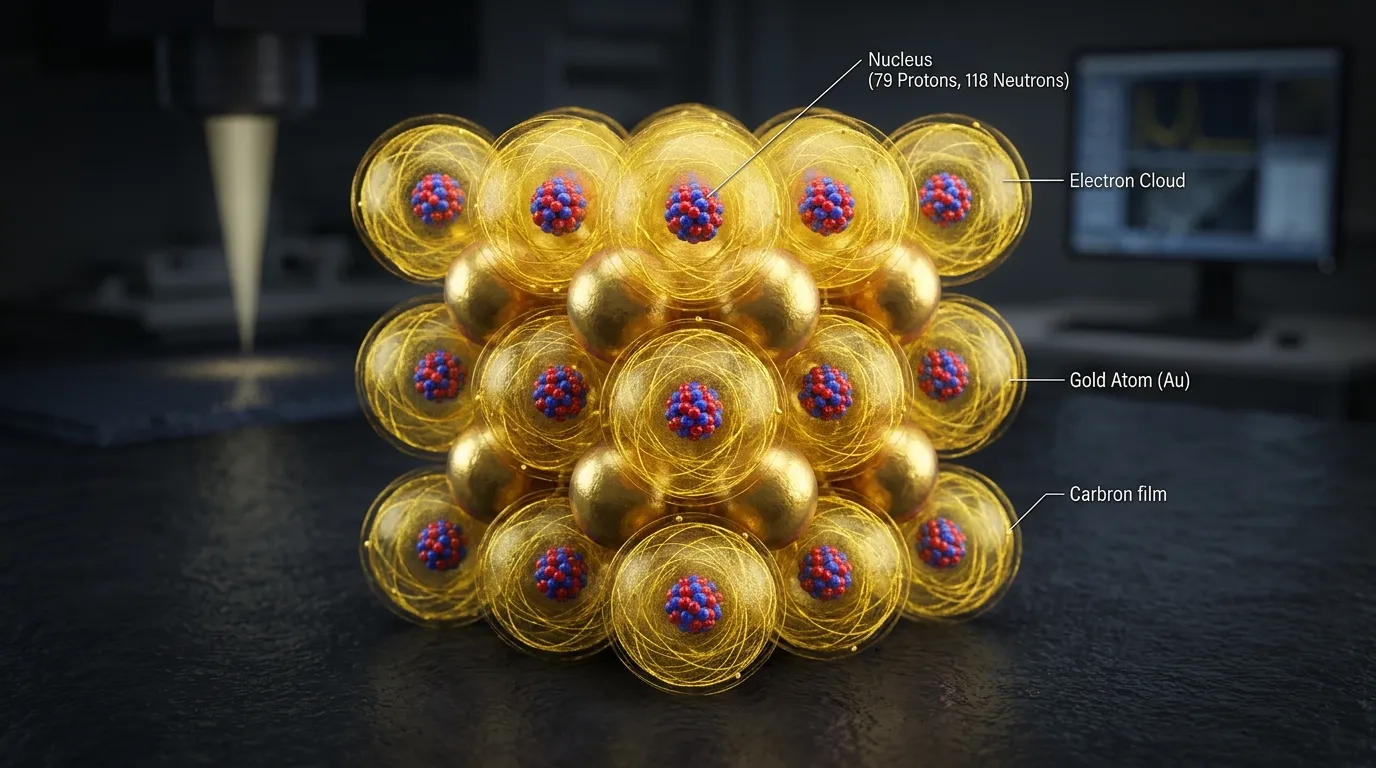
Gold’s atomic structure is defined by its atomic number: 79. This number is the most crucial identifying factor of the metal. Every single atom of gold in the universe contains exactly 79 protons in its nucleus. In its stable, uncharged state, a gold atom also features 79 electrons orbiting that nucleus in a complex cloud.
Additionally, the only naturally occurring, stable isotope of this element contains 118 neutrons. When you combine the 79 protons and the 118 neutrons, you get an atomic mass of roughly 197. This heavy, dense nucleus is what gives the metal its substantial weight and distinct physical characteristics. Because it is an element, you cannot break gold down into simpler substances through standard chemical reactions. It is fundamentally pure.
Born from the Stars: The Formation of Gold in the Universe
If you cannot create gold from other chemicals on Earth, where did it all come from? The answer is literally out of this world. The formation of gold requires conditions so extreme that they do not naturally exist anywhere in our solar system.
Scientists have determined that all the gold on Earth was forged in the hearts of dying stars. When massive stars reach the end of their life cycles, they collapse and explode in brilliant events known as supernovae. During these catastrophic explosions, the intense heat and pressure force lighter elements to fuse together, creating heavier elements.
More recently, astrophysicists have discovered that collisions between ultra-dense neutron stars are an even more prolific factory for heavy elements. When two neutron stars smash into each other, they trigger a rapid neutron-capture process (the r-process). This chaotic environment packs neutrons into atomic nuclei so quickly that they do not have time to decay, successfully forging incredibly heavy elements. The resulting stardust is then blasted across the galaxy.
Billions of years ago, this gold-rich dust mixed into the swirling cloud of gas and debris that eventually formed our solar system and planet Earth. So, whenever you wear a gold ring, you are wearing a tiny piece of cosmic history generated by colliding dead stars.
Where to Find It: Gold’s Natural Occurrence on Earth
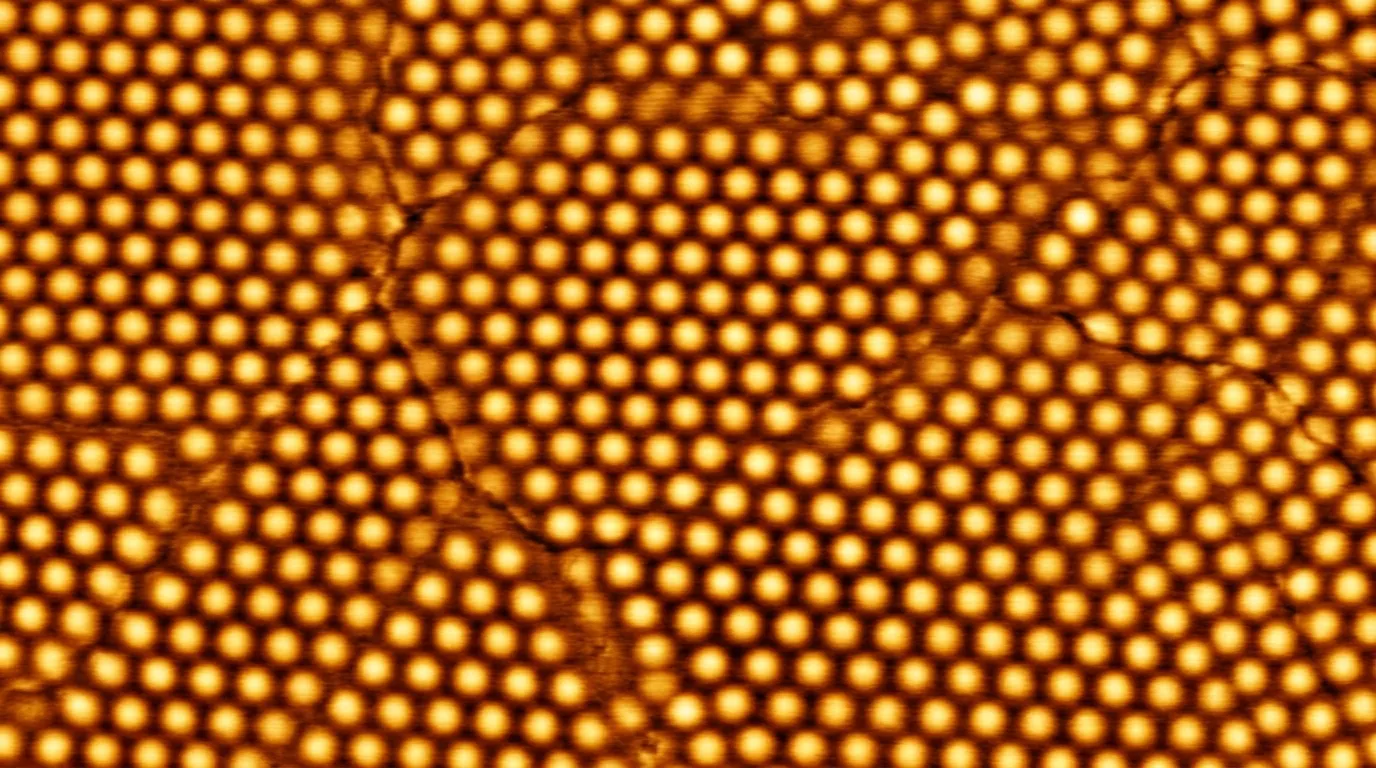
Because the Earth was completely molten during its early formation, most of the heavy iron and precious metals—including gold—sank straight to the center of the planet, forming the core. The gold we find in the Earth’s crust today is largely believed to have been delivered by asteroid impacts during an era known as the Late Heavy Bombardment, roughly four billion years ago.
Today, prospectors and mining companies find this metal in several distinct natural formations:
- Lode Deposits (Veins): These are concentrations of gold found in solid rock. Heated fluids deep within the Earth push the metal through cracks in the Earth’s crust. When the fluids cool, the gold precipitates out, often alongside quartz and fool’s gold (pyrite).
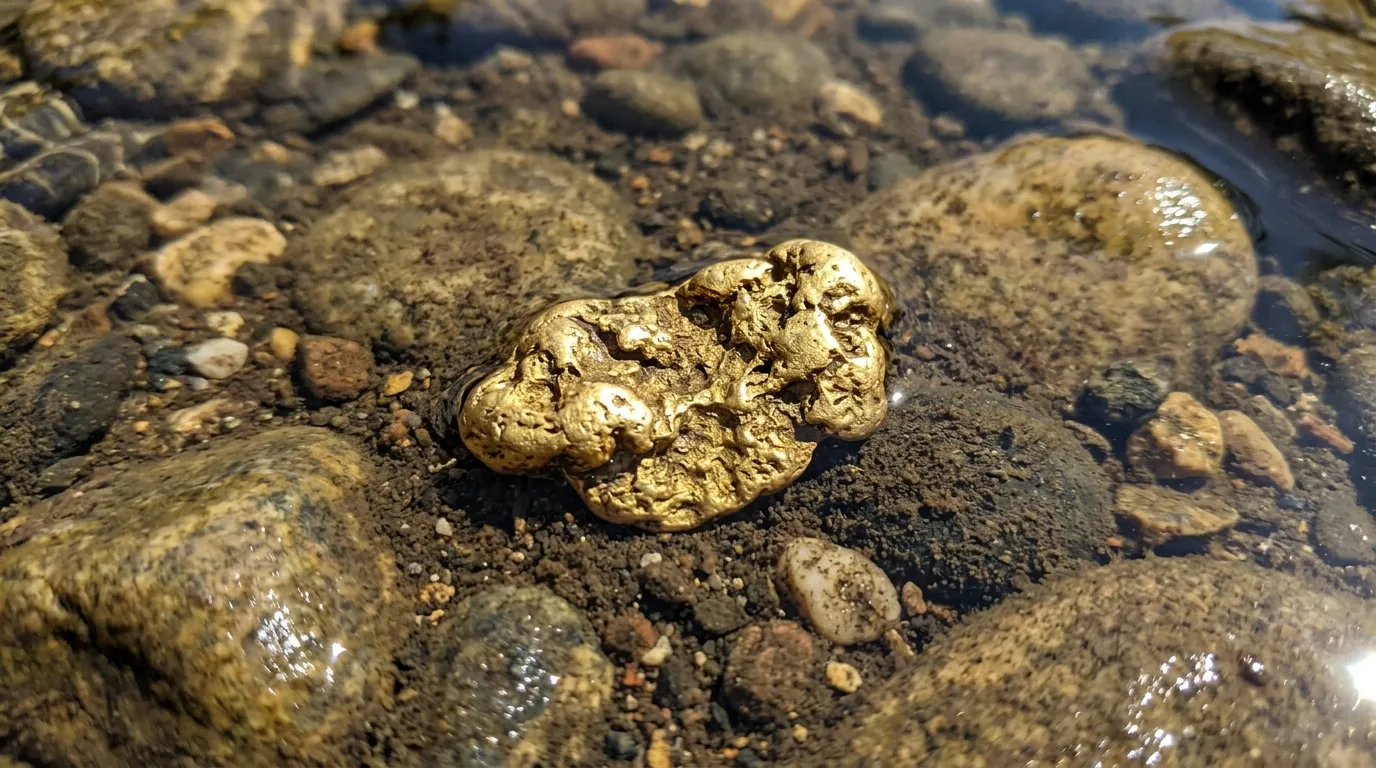
- Placer Deposits: When wind and water erode gold-bearing rocks over millions of years, the heavy metal washes into rivers and streams. Because it is so dense, it settles at the bottom of riverbeds, forming nuggets, flakes, and gold dust in gravel and sand.
- Seawater: Believe it or not, the world’s oceans contain billions of tons of dissolved gold. However, the concentration is so incredibly microscopic (a few parts per trillion) that it is currently economically impossible to extract it.
Shiny and Indestructible: Gold’s Properties
The enduring appeal of this metal comes down to its extraordinary physical and chemical characteristics. Gold’s properties make it unlike almost any other substance on the periodic table.
Physical Properties
- Extreme Malleability: Gold is the most malleable metal known to humanity. You can hammer a single ounce of it into a continuous, semi-transparent sheet covering roughly 300 square feet.
- Incredible Ductility: It is also highly ductile, meaning it can be stretched out into wire. That same single ounce can be drawn into a microscopic wire spanning over 50 miles without breaking.
- High Density: It is incredibly dense and heavy. A cubic foot of it weighs over half a ton.
- Thermal and Electrical Conductivity: It is a superb conductor of both heat and electricity, making it highly valuable in modern engineering.
Chemical Properties
- Noble Metal Status: Gold is incredibly unreactive. It does not combine easily with oxygen, meaning it will never rust, tarnish, or corrode under normal conditions. You can bury a coin in the ground or drop it in the ocean, and a thousand years later, it will still shine exactly as it did the day it was minted.
- Acid Resistance: It is immune to almost all single acids. It only dissolves in a highly specific, potent mixture of nitric and hydrochloric acids known as aqua regia (royal water).
Beyond Jewelry: The Practical Uses of Gold
When people think of this element, they typically picture wedding bands, necklaces, and treasure chests. While jewelry does account for around 50% of the global demand, the practical uses of gold extend far beyond mere decoration.
Electronics and Technology
Because it conducts electricity brilliantly and never corrodes, the tech industry relies heavily on it. Almost every sophisticated electronic device you own—including your smartphone, laptop, television, and gaming console—contains tiny amounts of gold in its circuitry and connectors. It ensures rapid, reliable data transmission that won’t degrade over time.
Medicine and Dentistry
Dentists have used this metal for thousands of years. It is non-toxic, biocompatible (meaning the human body does not reject it), and malleable enough to form perfect crowns, bridges, and fillings. In modern medicine, microscopic nanoparticles are used in rapid diagnostic tests, targeted drug delivery systems, and even specific experimental cancer treatments.
Aerospace
The aerospace industry uses thin films of this noble metal to protect spacecraft and astronauts. Because it reflects infrared radiation (heat) so effectively, a thin coating on the visors of astronaut space suits protects their eyes from the unfiltered, searing heat of the sun. It is also used to coat sensitive instruments on satellites and telescopes.
Financial Reserves and Investment
Historically, the metal served as the direct backing for paper currencies worldwide. While the gold standard is no longer in official use, central banks around the globe still hold thousands of tons of it in their reserves to hedge against inflation and economic instability. Individual investors also purchase coins, bullion, and bars to protect their wealth.
Myths and Truths: Common Misconceptions
Throughout history, this legendary metal has inspired countless myths. Let’s clear up a few common misconceptions.
Misconception 1: Alchemists can make gold from lead.
For centuries, medieval alchemists tried to find the “Philosopher’s Stone” to transmute cheap base metals like lead into precious gold. Chemically, this is impossible. You cannot change one element into another using chemistry. However, modern physicists actually can create gold by bombarding elements like mercury or platinum with neutrons in a nuclear reactor. Unfortunately, this process is incredibly dangerous, yields microscopic amounts, and costs millions of times more than the metal is actually worth.
Misconception 2: Biting a coin proves it is real.
You have probably seen movie characters bite a coin to check its authenticity. Because the pure element is relatively soft, teeth will leave a mark. However, lead is also soft. Biting a lead coin plated in yellow metal will leave a dent, too, making this a terrible (and unhygienic) test.
Misconception 3: “White gold” is a naturally occurring element.
There is no such thing as naturally occurring white, rose, or green gold. The element is fundamentally yellow. To change its color and increase its durability for jewelry, jewelers mix (alloy) it with other metals. White gold is created by mixing it with palladium, nickel, or silver. Rose gold is created by adding copper.
Precious Metals Showdown: Comparison Table
How does this legendary metal stack up against its closest competitors?
|
Feature |
Gold (Au) |
Silver (Ag) |
Platinum (Pt) |
|---|---|---|---|
|
Atomic Number |
79 |
47 |
78 |
|
Density (g/cm³) |
19.32 |
10.49 |
21.45 |
|
Melting Point |
1,064°C (1,947°F) |
961°C (1,763°F) |
1,768°C (3,215°F) |
|
Corrosion Resistance |
Excellent (Does not tarnish) |
Moderate (Tarnishes easily) |
Excellent (Does not tarnish) |
|
Primary Industrial Use |
Electronics, Aerospace |
Solar panels, Medicine |
Catalytic converters |
|
Relative Hardness |
Very Soft |
Soft |
Hard |
Pro Tips and Common Mistakes: How to Identify Real Gold
If you are buying jewelry or investing in coins, you need to know how to spot the real deal and avoid getting scammed by counterfeits.
Pro Tips for Verification
- Look for Hallmarks: Genuine pieces of jewelry are almost always stamped with a hallmark that denotes purity. You will see markings like 24K (100% pure), 18K (75% pure), or 14K (58.3% pure). You might also see decimal stamps like .999 or .750.
- The Magnet Test: Pure precious metals are completely non-magnetic. If you hold a strong neodymium magnet to a chain or coin and it sticks, it contains a significant amount of iron, nickel, or steel. Keep in mind, however, that a non-magnetic result does not guarantee authenticity, as counterfeiters often use non-magnetic base metals like copper or brass.
- The Density Test: Because the element is so exceptionally dense, it displaces water in a very specific way. Professionals use a specific gravity test by weighing the item in the air and then weighing it while suspended in water to calculate its exact density.
- Professional Acid Testing: Jewelers use specific drops of nitric acid to test authenticity. Since genuine pieces do not react to the acid, any bubbling, fizzing, or green coloration instantly reveals a fake or low-karat piece.
Common Mistakes to Avoid
- Mistaking Pyrite for the Real Thing: Pyrite, commonly known as “Fool’s Gold,” has a brassy, yellow appearance. However, pyrite forms in sharp, brittle geometric crystals, whereas the genuine element is smooth, soft, and lacks crystalline edges. If you hit pyrite with a hammer, it shatters; genuine pieces will just dent and flatten out.
- Ignoring “Plated” Marks: Be wary of stamps that say “GP” (Gold Plated), “GF” (Gold Filled), or “GEP” (Gold Electroplated). These items are made of cheap base metals covered by a microscopically thin layer of the precious metal that will inevitably wear off over time.
Conclusion
So, what is gold made of? It is a singular, pure chemical element boasting 79 protons, born in the catastrophic explosions of ancient stars and delivered to Earth billions of years ago. From its unbreakable atomic structure to its incredible resistance to corrosion, this noble metal continues to be a cornerstone of human civilization. Whether it is facilitating high-speed data in your phone, capping a tooth, or shining brilliantly on your finger, the enduring legacy of this element is truly unparalleled.
Ready to start your own collection? Always consult with certified dealers and use the pro tips outlined above to ensure you are securing a genuine piece of the cosmos.
Frequently Asked Questions (FAQs)
1. Is gold a mineral or an element?
It is actually both. On the periodic table, it is a chemical element represented by the symbol Au. However, because it occurs naturally in the Earth as a solid, inorganic substance with a specific atomic structure, geologists also classify it as a native mineral.
2. Can humans manufacture gold artificially?
Yes, but it is not practical. Scientists can create microscopic amounts of it by bombarding lighter elements like mercury with neutrons in a nuclear reactor or particle accelerator. However, the process is highly radioactive and costs far more than the resulting metal is worth.
3. What does the “Karat” (K) system mean?
The karat system measures the purity of the metal out of 24 parts. 24K is 100% pure. 18K means the item is 18 parts pure element and 6 parts alloy metals (75% purity). 14K means it is 14 parts pure and 10 parts alloy (58.3% purity).
4. Why do jewelers mix gold with other metals?
In its purest 24K form, the metal is exceptionally soft—so soft that a pure ring would quickly bend, scratch, and warp out of shape during everyday wear. Jewelers add metals like copper, silver, and zinc to increase its hardness, durability, and scratch resistance.
5. What is Fool’s Gold made of?
Fool’s Gold is actually a mineral called iron pyrite. Its chemical makeup is iron disulfide. While it has a shiny, pale brass-yellow hue that easily fools amateur prospectors, it is brittle, creates a blackish streak when scratched against a rough surface, and contains absolutely no precious metal.
6. Does pure gold ever tarnish or rust?
No. It is a “noble metal,” meaning it is highly unreactive to oxygen and moisture. It will never rust, oxidize, or tarnish. If a piece of jewelry starts turning green or tarnishing, it means the alloy metals mixed into it (like copper or silver) are reacting, or the piece is simply plated over a cheap base metal.
7. How much gold has been mined in human history?
Experts estimate that roughly 200,000 to 210,000 tonnes have been mined throughout all of human history. Because it is virtually indestructible, almost all of it is still around today. If you gathered all of it together, it would fit into a cube measuring roughly 72 feet on each side.
8. Are there traces of gold in the human body?
Yes. The average human body contains microscopic trace amounts of it—roughly 0.2 milligrams. Most of this is found circulating in our blood and within our joints, though it serves no known vital biological function.
9. Can gold be destroyed?
In everyday terms, no. It cannot be burned away, rusted, or corroded by normal means. However, it can be dissolved into a liquid state using a harsh chemical mixture called aqua regia, and it can be vaporized at incredibly high temperatures (above 5,000 degrees Fahrenheit). Even then, the atoms still exist; they just change form.
10. Why is gold used in electronics?
It is used in electronics because it is a highly efficient conductor of electricity and, most importantly, it does not corrode. While copper and silver are also great conductors, they oxidize and tarnish over time, which degrades electrical connections. Using this noble metal ensures connections remain flawless for the lifetime of the device.