Have you ever wondered about the true origin of the jewelry you wear? The fascinating story of how gold is formed begins billions of years ago in space.
This definitive guide explores the extraordinary journey of gold, from its creation in violent cosmic explosions to its arrival on Earth via asteroid bombardment. We analyze the r-process, kilonovas, and the complex hydrothermal geological systems that concentrate this rare element into minable veins for the global market.
The question of how gold is formed is one that bridges the gap between the furthest reaches of the universe and the deepest mines on Earth. Unlike elements like carbon or oxygen, which stars produce during their standard lifecycles, gold requires conditions of such extreme heat and pressure that they only occur during the death throes of massive stars or the collision of hyper-dense stellar remnants. To understand the formation of precious metals, we must first look toward the stars.
The Cosmic Origin: Beyond Stellar Fusion
Most elements in the periodic table are forged through nuclear fusion within the cores of stars. Our Sun, for example, is currently fusing hydrogen into helium. As massive stars age, they begin fusing heavier elements such as carbon, neon, and oxygen. However, this process hits a physical wall at iron. Fusing iron consumes more energy than it releases, leading to a catastrophic collapse of the star’s core.
Because iron is the “ash” of nuclear fusion, the universe needs a more violent mechanism to create heavier elements like gold. This brings us to the two primary theories of how gold is formed in the cosmos: Supernovae and Neutron Star Mergers.
The r-Process in Supernovae
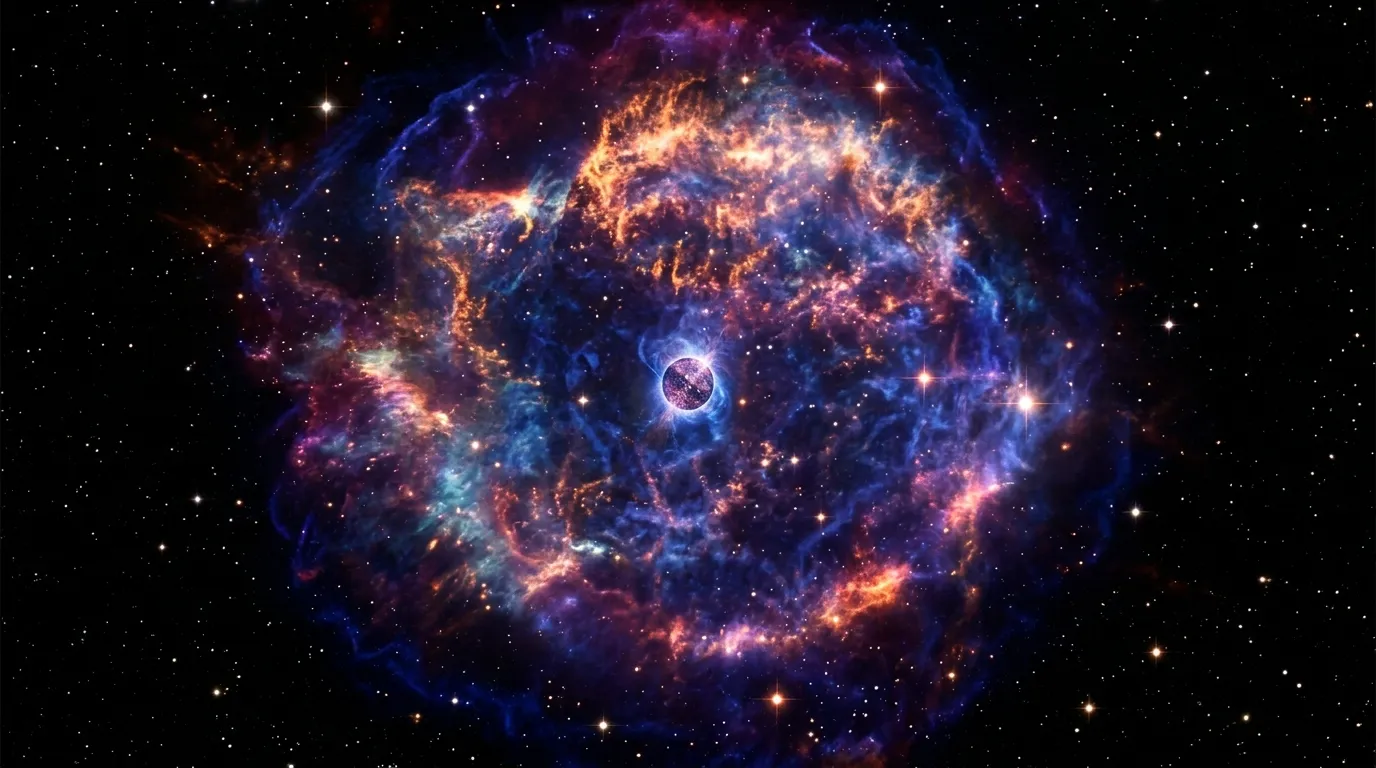
When a star at least eight times the mass of our Sun exhausts its fuel, it explodes in a supernova. During these brief, intense seconds, a phenomenon known as the “r-process” (rapid neutron-capture process) takes place. In this environment, atomic nuclei are bombarded by a massive flux of neutrons. These nuclei capture neutrons so quickly that they don’t have time to decay before capturing another. This rapid accumulation builds heavy, unstable isotopes that eventually decay into stable gold atoms.
Kilonovas: The Ultimate Gold Forge
While supernovae contribute to the gold supply, recent data from the LIGO Gravitational Wave Observatory suggests that the majority of the universe’s gold comes from “kilonovas.” A kilonova occurs when two neutron stars—the collapsed cores of dead giants—collide.
These stars are so dense that a single teaspoon of their material would weigh billions of tons. When they merge, they release a spray of neutron-rich debris. Scientists estimate that a single neutron star collision can produce an amount of gold equivalent to several times the mass of the Earth. This cosmic dust eventually settles into nebulae, the birthplaces of new solar systems like our own.
Earth’s Arrival: The Late Heavy Bombardment
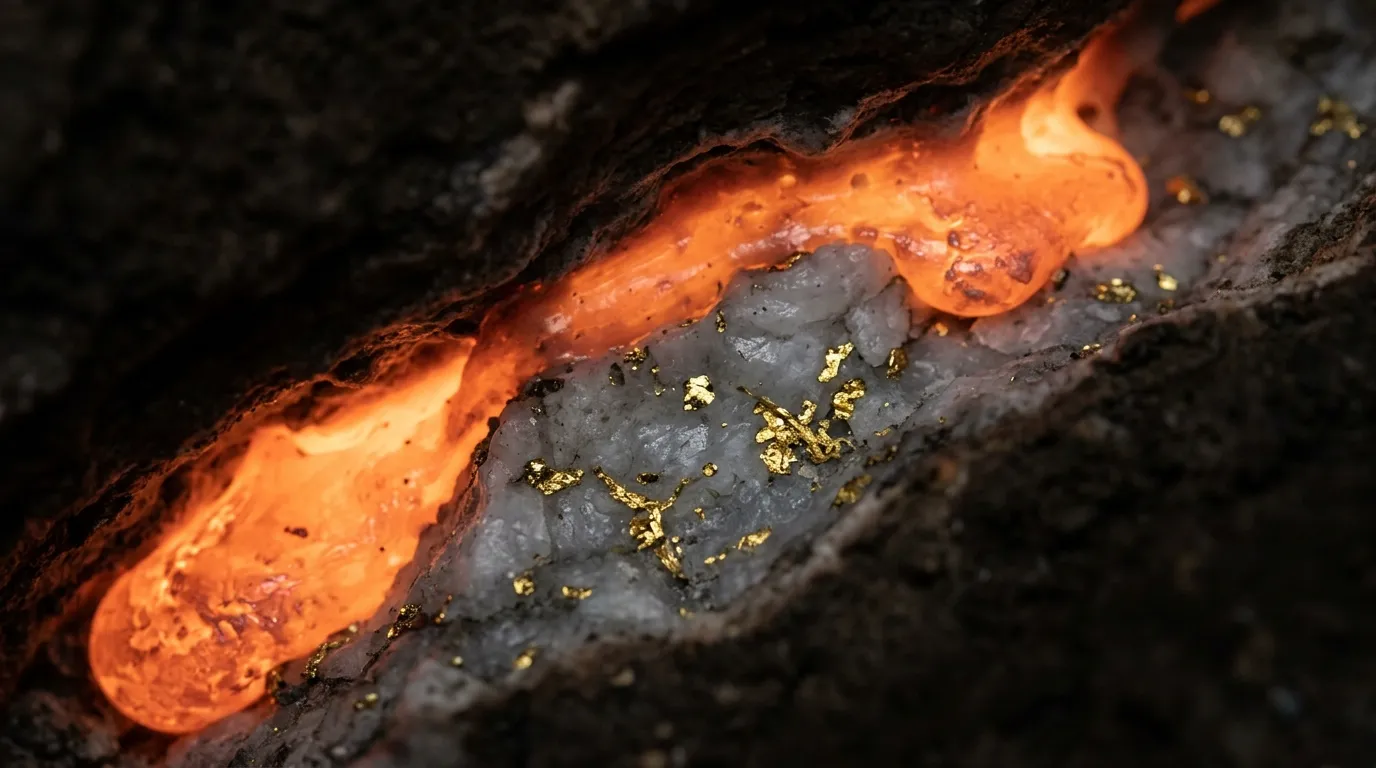
If the Earth was formed from a nebula containing gold, you might expect it to be evenly distributed. However, during Earth’s early “molten” stage, heavy metals like iron and gold sank into the planet’s core due to gravity. This process is known as planetary differentiation.
If this were the end of the story, the Earth’s crust would be completely devoid of gold. The reason we have access to it today is thanks to the “Late Heavy Bombardment.” Roughly 4 billion years ago, a massive influx of gold-bearing asteroids struck the cooling Earth. Because the crust had already solidified, the gold delivered by these impacts remained trapped in the upper mantle and crust rather than sinking to the core. This event is a critical chapter in the global gold supply chain as it provided the raw materials for all future mining.
Geological Concentration: From Dust to Veins
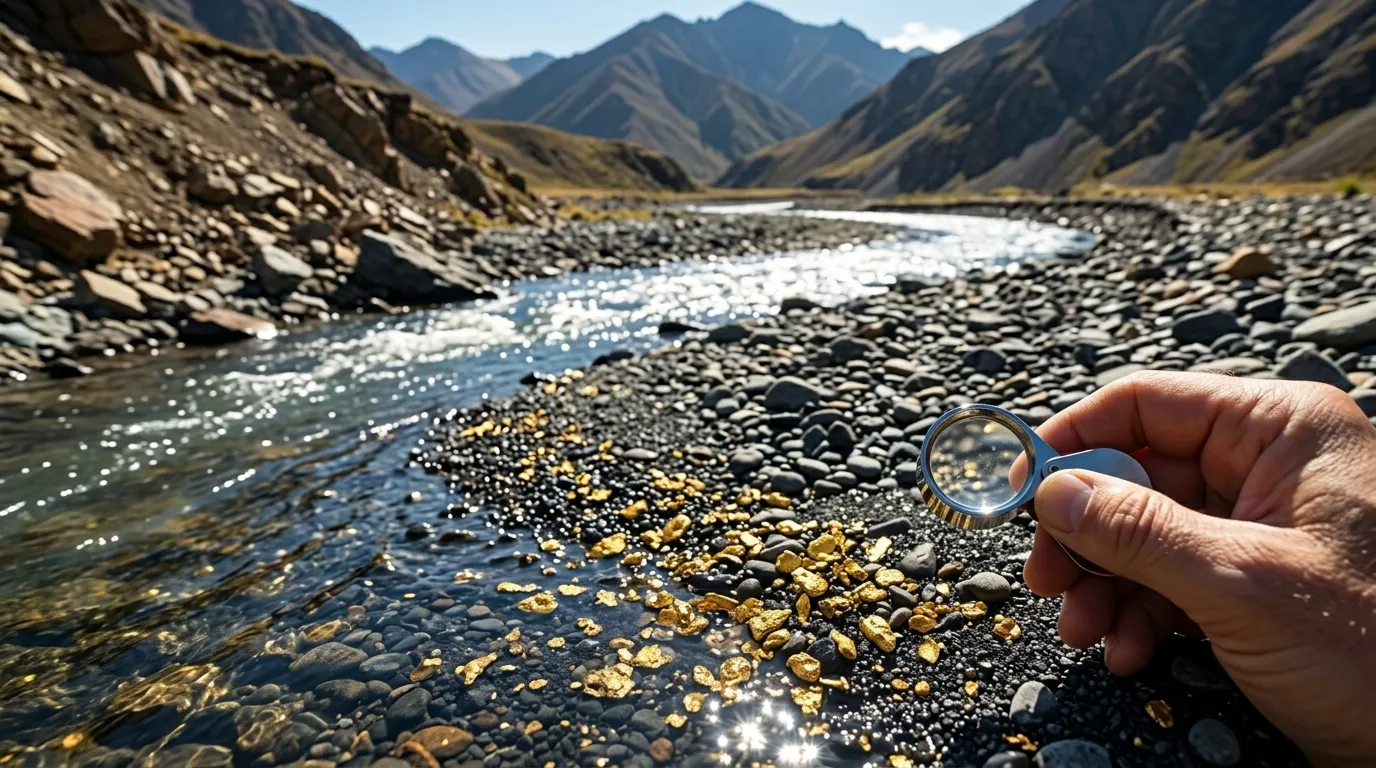
Even after the asteroids delivered gold to Earth, it was still spread too thin to be useful. It required millions of years of geological activity to concentrate these atoms into the “deposits” we mine today.
Hydrothermal Fluid Systems
The most common way gold is concentrated is through hydrothermal activity. Deep in the Earth’s crust, water is heated by underlying magma. This superheated water becomes highly pressurized and chemically reactive, allowing it to dissolve trace amounts of gold from surrounding rock.
As these fluids are forced upward through cracks and fissures (faults), they begin to cool. The change in temperature and pressure causes the gold to “precipitate” out of the solution, often forming veins alongside quartz. These veins are the primary targets for modern metal extraction operations.
Tectonic Activity and Orogenic Gold
The movement of Earth’s tectonic plates plays a massive role in how gold is formed into minable provinces. When plates collide, they create mountain ranges (orogeny). The immense pressure and heat generated during these collisions squeeze gold-bearing fluids out of the rock and into concentrated “lode” deposits. This is why many of the world’s largest gold mines are located in mountainous or former volcanic regions.
Types of Gold Deposits
Understanding the different types of deposits is essential for anyone interested in the technical side of geology or precious metal investment.
| Deposit Type | Formation Process | Key Location Example |
|---|---|---|
| Lode/Vein Deposits | Hydrothermal fluids in rock fissures | Mother Lode, California |
| Placer Deposits | Erosion and water-based gravity separation | Yukon River, Canada |
| Porphyry Deposits | Large-scale volcanic igneous intrusions | Grasberg Mine, Indonesia |
| Epithermal Deposits | Shallow, low-temperature volcanic systems | Hishikari Mine, Japan |
Placer Gold and the Power of Erosion
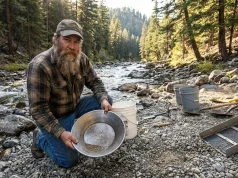
Nature also has its own way of “mining” gold. Over millions of years, wind and water erode gold-bearing mountains. Because gold is 19.3 times heavier than water, it doesn’t wash away easily. It settles in the bends of rivers and at the bottom of stream beds. These are known as placer deposits. This was the source of the famous 19th-century gold rushes, where prospectors used simple pans to separate the heavy gold from the lighter sand.
The Science of Rarity
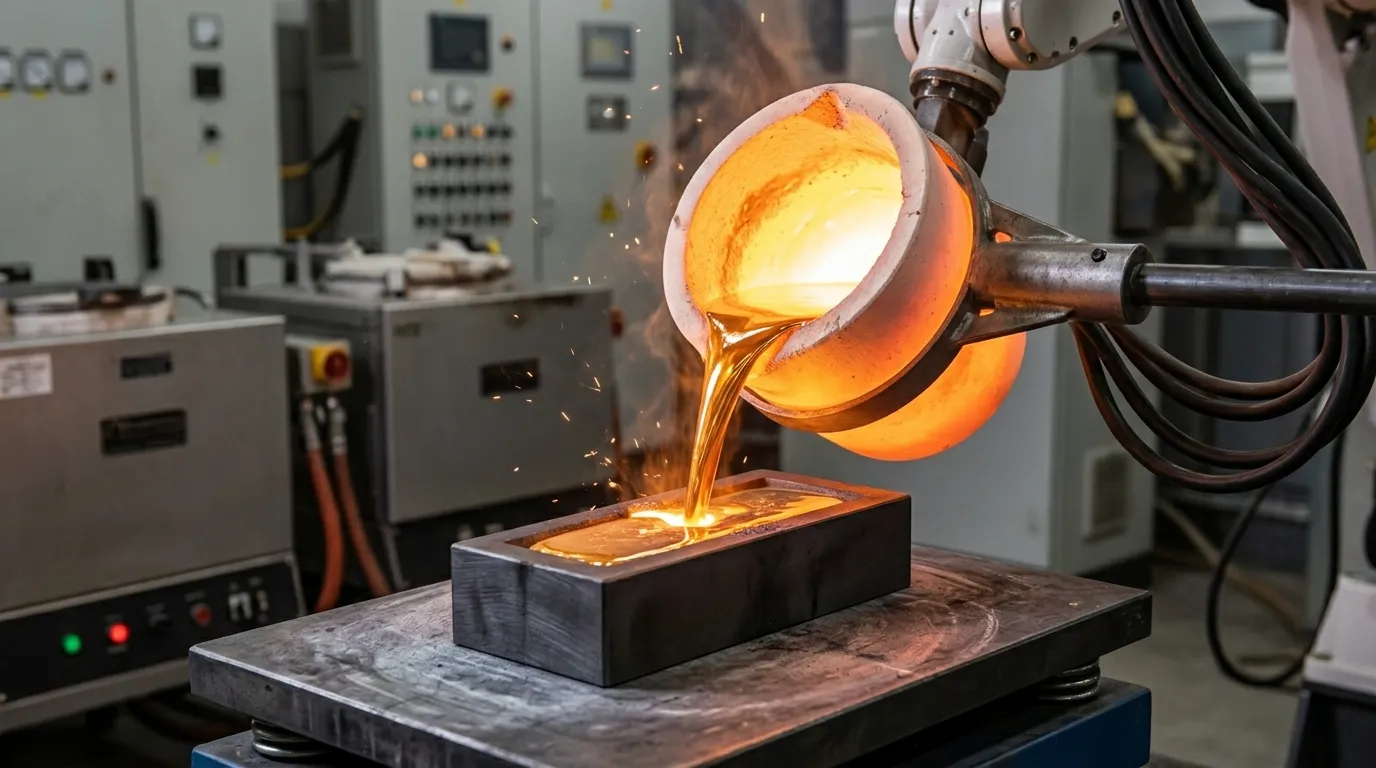
To put the rarity of how gold is formed into perspective, we must look at its abundance in the Earth’s crust. Gold is found at a concentration of approximately 0.004 parts per million (ppm). In contrast, iron makes up about 50,000 ppm of the crust.
This scarcity is why the mining environmental impact must be carefully managed; miners often have to process one ton of rock just to extract five grams of gold. This massive energy requirement is a primary driver of gold’s high market price.
Expert Insights: The Future of Gold Formation
While we cannot wait millions of years for new gold to form geologically, scientists are looking at “biogeochemical” gold formation. Some microbes and bacteria actually have the ability to dissolve and reprecipitate gold, creating small grains of the metal in soil. While not yet a commercial source, it shows that the story of how gold is formed is still being written.
Common Mistakes to Avoid in Gold Geology
- Confusing Pyrite with Gold: Often called “Fool’s Gold,” pyrite is an iron disulfide. You can tell the difference because pyrite is brittle and shatters, while gold is malleable and bends.
- Thinking Gold is “Growing”: Gold does not grow like a plant. It is an element. Any “new” gold found in a previously mined area is simply gold that has been moved there by erosion or water flow.
- Assuming Volcanoes Create Gold: Volcanoes only provide the heat and the pathways for gold-bearing fluids; they do not “create” the gold atoms themselves.
Modern Extraction and Economics
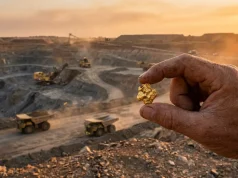
Once we find where the gold has been concentrated, the metal extraction process begins. This involves crushing the ore and using chemical processes like cyanidation or smelting to separate the pure metal.
Today, the top producers of gold include:
- China: Leading global production through massive state-run operations.
- Australia: Utilizing advanced technology to mine deep-seated orogenic deposits.
- Russia: Expanding its reach into the Siberian wilderness.
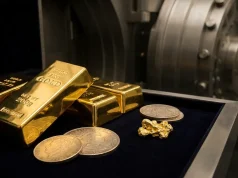
The high cost of these operations, combined with the difficulty of finding new deposits, ensures that the global gold supply chain remains tight, supporting gold’s role as a hedge against inflation.
Conclusion
The incredible reality of how gold is formed reminds us that every piece of gold on Earth has a cosmic pedigree. From the heart of a kilonova to the deep hydrothermal vents of our planet, gold is a testament to the universe’s most powerful forces. Whether you are interested in it for its beauty or as a precious metal investment, understanding its origin makes it all the more valuable.
Explore our other guides to learn more about the mining environmental impact and how to start your own mineral collection today!
Frequently Asked Questions
1. Can we make gold in a lab?
Yes, it is possible to create gold using a particle accelerator or a nuclear reactor by bombarding mercury or platinum with neutrons. However, the energy cost is so high that the gold produced costs millions of dollars per ounce, making it commercially impossible compared to natural mining.
2. Is there gold in the ocean?
There are approximately 20 million tons of gold dissolved in the world’s oceans. However, the concentration is only about 13 billionths of a gram per liter of water. There is currently no cost-effective way to extract it.
3. Why is gold yellow if it comes from stars?
Gold’s color is a result of Einstein’s theory of relativity. The large number of protons in a gold nucleus causes electrons to move so fast that they gain mass. This shifts the way the atom absorbs light, reflecting yellow light instead of the silver color seen in other metals.
4. How much gold is left to mine?
The US Geological Survey estimates that there are about 57,000 tons of “below-ground stock” left to be mined. This represents about 20% of all the gold that exists on Earth.
5. Does gold ever rot or tarnish?
No. Gold is one of the “noble metals.” It does not react with oxygen, meaning it will never rust or tarnish. Gold recovered from 3,000-year-old Egyptian tombs still looks as bright as the day it was forged.
6. What is “White Gold”?
White gold is not a natural form of gold. It is an alloy made by mixing pure gold with white metals like palladium, silver, or nickel, and then coating it with rhodium for a mirror-like finish.
7. How deep is the deepest gold mine?
The Mponeng Gold Mine in South Africa is the deepest in the world, extending over 4 kilometers (2.5 miles) below the Earth’s surface. At that depth, the rock temperature is around 150°F.
8. Is gold used in medicine?
Yes. Because gold is biocompatible and highly conductive, it is used in dentistry, specialized cancer treatments, and even in rapid COVID-19 test kits.
9. What was the “Gold Standard”?
The gold standard was a monetary system where a country’s currency had a value directly linked to gold. Most countries, including the US, moved away from this system in the 20th century in favor of fiat currency.
10. Why is gold so heavy?
Gold is incredibly dense because its atoms are very heavy and packed very tightly together. A one-foot cube of gold weighs over 1,200 pounds, which is more than the weight of a full-grown grizzly bear.